
Getting found · 4 min read
What is a landing page, and do I need one?
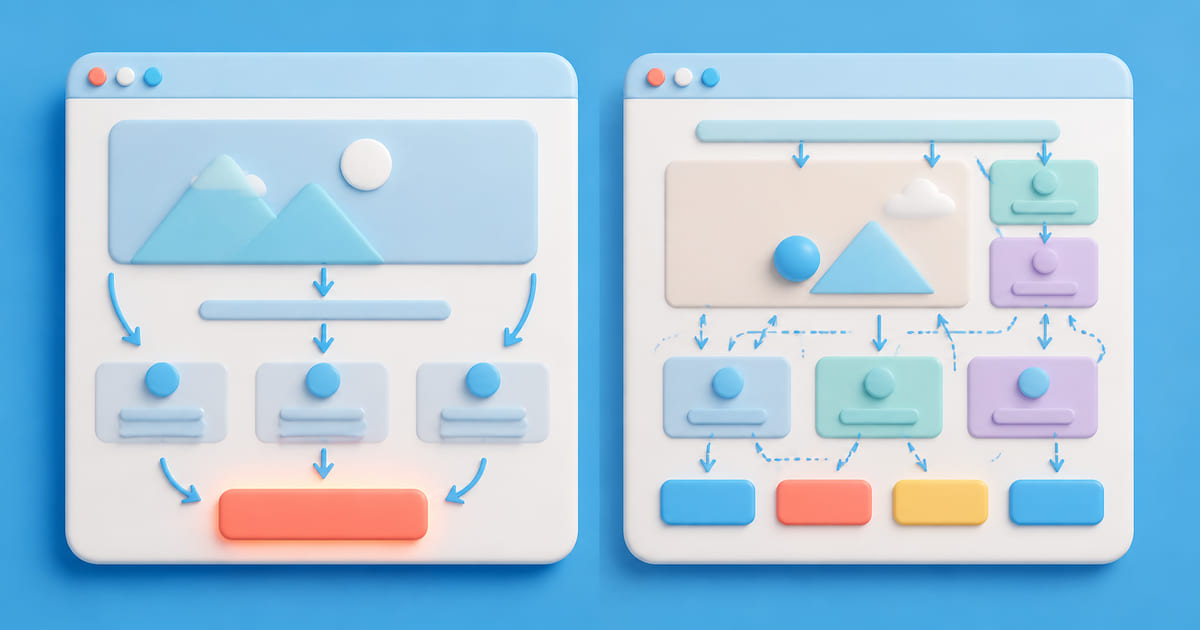
The short answer
A page built around a single action, with everything that would distract from it removed. Most small businesses do not need one — they need their existing pages to have a clear action. Landing pages earn their place when you are running ads and paying for each visitor, because a page with one route converts better than a homepage with nine.
On this page
What makes it a landing page
Not where it sits or what it is called. The absence of alternatives.
A homepage offers navigation, several services, an about section, social links and a footer full of options. A landing page offers one thing: the action you want, everything supporting it, and nothing competing with it.
Frequently that means no navigation menu at all — which feels wrong the first time and is the entire point. Every additional route is a chance to leave without doing the thing.
When you actually need one
You are paying per click. This is the main case. If an ad costs money for every visitor, sending them to a homepage where they have to find the offer wastes a proportion of every pound. A page matching the ad exactly converts substantially better.
A single campaign with a specific offer. An opening promotion, a seasonal package, an event.
One service that deserves its own focus, where the rest of your business is a distraction from it.
When you do not
Most of the time. If people are arriving from search and browsing normally, they want to look around — removing navigation from those pages hurts rather than helps.
As a substitute for a clear homepage. If your homepage does not say what you are and what to do next, build a better homepage. A landing page is not a workaround for that.
Because you read that you should have one. A landing page nobody sends traffic to is just a page with less navigation.
What goes on it
In order:
One headline that matches what they clicked. If your ad said "emergency plumber, 24 hours", the page says that, in those words. A mismatch here is where most landing page budget is lost — the visitor thinks they clicked the wrong thing.
The specific offer, stated plainly.
One action, repeated as you scroll but always the same action.
Enough proof to be believed — a couple of reviews, a certification, a real photograph.
The essential objection handled. Price, availability, location, whatever normally stops people.
Nothing else. No navigation, no unrelated services, no newsletter signup competing with the booking.
The mistake that wastes them
Sending ad traffic to the homepage.
It is the default, it feels harmless, and it silently reduces the return on every campaign. Someone who clicked an ad about a specific thing lands on a page about everything, has to search for what they wanted, and a meaningful share simply leave.
If you are running ads and doing nothing else on this page, do that one thing: send each ad to a page about the thing the ad promised.
The version most small businesses should build first
Not a landing page. A homepage that behaves a bit more like one.
Say what you are and where in the first screen. Make one action obvious. Put the answers people came for within a click. Cut the things nobody uses.
That improves every visit rather than only the paid ones — and if you later run ads, you will have a much better idea of what the landing page should say.
The reason most businesses do not have one
Everything above describes why a landing page works. The reason most small businesses run campaigns without one is not disagreement — it is that a new page is a request.
A landing page is worth having when it can be made in an afternoon, tested, and thrown away if the campaign does not work. That is the whole economic case. If making one means a quote, a brief and a week, the arithmetic collapses: you spend more producing the page than the campaign was going to earn, so you point the ads at the homepage instead and lose most of them there.
So the practical question is not "should I have a landing page" but can I make one without raising a job? Helm's answer is that page content, titles and descriptions are yours to write in the dashboard, so a page for a campaign is an afternoon rather than a project. The design stays consistent with the rest of the site — which is a feature, not a limitation, since a landing page that looks like a different company is its own conversion problem.