
Bookings · 6 min read
How do salons and barbers take online bookings?
The short answer
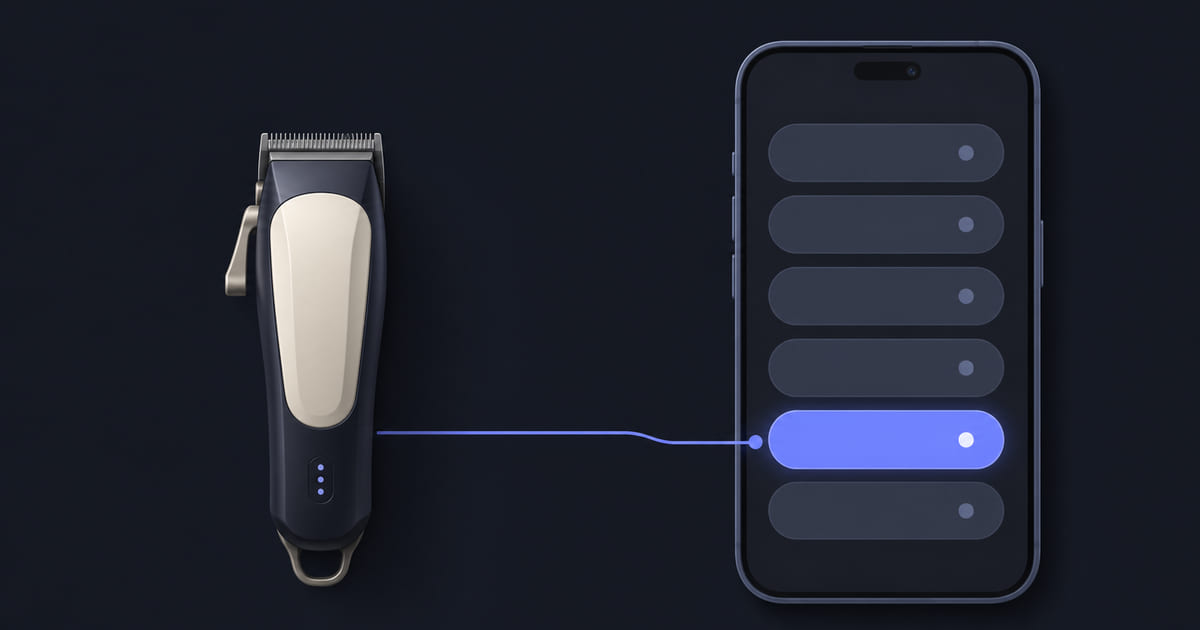
Three routes. A marketplace app lists you and charges a fee on every booking, including your regulars. A standalone booking tool costs a flat monthly fee and sits on your own site. Or bookings are part of the site itself. For a salon or a barber the decision is usually not about features — it is about whether you pay a cut on the customer who has been coming to you for four years.
On this page
The three routes
A marketplace app. You appear in a directory, customers find you, and you pay per booking or a monthly fee plus a cut. Real discovery value, real ongoing cost.
A standalone booking tool. A flat monthly fee, a booking page you link to, sometimes embedded into your own site. No commission, but a second subscription and a second place to keep your hours correct.
Bookings as part of your website. No commission, no second system, and the booking page is on your own domain — so a customer who searched your shop by name never leaves it.
The question that actually decides it
Not features. This: which customer is the fee being charged on?
A new client who found you by browsing the app is someone you did not have. Paying a fee for that is buying marketing, and it can be entirely worth it.
A regular who typed your shop's name into their phone, tapped the first result, and happened to land on a marketplace listing is a customer you already had. The fee there buys nothing — you paid for a booking that was coming anyway. For a barbershop, where the same faces come back every three or four weeks, and for most established salons, that second group is most of your bookings.
Work out the annual number before you decide. Per-booking fees are designed to feel small; the yearly figure is the one that matters. Take a modest salon: 40 bookings a week, a typical marketplace commission on each.
The exact multiple depends on your prices and the platform's rate, so do it with your own numbers: weekly bookings, times the fee, times fifty. The shape is always the same, and it has one property worth noticing: the marketplace cost rises as you get busier. Own-site booking does not. You are buying the same software either way; on one of them the price is indexed to your success.
The arrangement that keeps both
Stay on the marketplace if it genuinely brings new people. Put your own booking page on your own site. Then make sure that when somebody searches your shop by name, your site is the first result rather than your listing — which is a matter of the basics in how do I rank for my own business name.
Then tell your regulars once: "You can book us directly here — it is the same slots." Most will, because it is faster.
You pay a fee on new customers and nothing on your regulars, which is roughly the deal you thought you were signing up for.
What your own booking page needs to do
The reason people stay on marketplaces is rarely loyalty. It is that the marketplace booking flow works and their own site's does not. To win the switch, yours needs to:
- Work in three taps or fewer, on a phone, without creating an account
- Show real availability, not a request form that waits for someone to reply
- Send a confirmation and a reminder — the reminder is what reduces no-shows, and it is why people trust platforms
- Let staff be picked if your clients book with a specific stylist or barber, because they will not switch to something that cannot do that
- Take a deposit if no-shows are a problem for you — standard practice in a tattoo studio, where the booking is long and the no-show costs a day, and worked through for barbers below
Miss any of those and clients drift back, and you end up paying commission anyway.
The deposit question
The other thing barbers ask about, and it matters more than the software.
No-shows are the real cost in this trade — a thirty-minute gap on a Saturday is money that does not come back. A small deposit removes most of them, and the objection is always the same: will it put people off?
In practice a modest deposit, clearly explained, deducted from the price, filters out almost nobody who was genuinely going to turn up. What matters is that the policy is visible before someone books rather than discovered at the end, and that cancelling within your notice window is easy and refunds automatically. A deposit that feels like a trap costs you more than the no-shows did. And before you add one at all, check how many of your no-shows simply forgot: a message the day before prevents more of them than a deposit does.
Barbers are not the only ones
Worth saying, because "bookings" gets read narrowly. The same problem and the same three routes apply to anything where a customer takes a slot of your time or your space: salons, tattoo studios, physiotherapists, driving instructors, photographers, clinics, gyms, padel courts, meeting rooms, workshops. The software is the same. What changes is the policy around it — slot length, deposit, notice period — and that is configuration rather than a different product.
The part worth more than the saving
The customer relationship. On your own booking system you have the client's contact details, their history and their preferences, and you can message them. On a marketplace, that relationship often belongs to the platform: you may not get the email address, and you cannot contact the person who came in last month. That is the more expensive loss over several years; the commission is just the part with a number on it.
Where Helm fits
Bookings is a module on the same dashboard as your website. You get a booking requests inbox and the chairs or rooms behind it, and the form goes onto the site you already have — no rebuild, no second subscription, no second login.
To be plain about the list above: Helm's bookings are requests today. A customer picks a chair or room and a preferred date, you confirm or decline, and they get an email with your answer. It does not show live availability, send reminders, let the customer pick a stylist or take a deposit. If those are what keep your regulars on a marketplace, keep the marketplace for them for now.
Two consequences worth naming. It is a flat cost, so getting busier does not increase what you pay — the opposite of the marketplace arithmetic above. And the bookings arrive next to your enquiries and your customer list rather than in a separate system nobody checks on a Sunday.
If you also want a reason for people to come back, Loyalty is a stamp card on the same customer account — every sixth cut free, or whatever you choose, redeemed by a code at the chair, living on your own site with nothing for the client to install. There is a fuller walkthrough of a loyalty programme for a salon or barber.
If you do not need any of that, it is not switched on. A module manager keeps the dashboard to the parts your shop actually runs on.