
Getting found · 4 min read
Why doesn't my website come up when I search my own business name?
The short answer
Usually one of three things: a directory or delivery platform outranks you because it has more authority, your business name is a common phrase competing with unrelated results, or your site is not indexed at all. Check whether you appear at all first — being on page two for your own name is a different problem from being absent, and the fixes are different.
On this page
Establish which problem you have
Three very different situations get described the same way. Search your business name and look carefully:
You appear, but below a directory or delivery platform. Common, annoying, and the least serious. You are findable; you are just not first.
You appear nowhere at all, but your Google Business Profile shows. Then indexing is your problem, not ranking.
Nothing about you appears at all. Either you have no profile and no indexed site, or your name is being interpreted as something else entirely.
The fix depends entirely on which of these it is, so do not skip this step.
If a directory outranks you
This happens because those sites have enormous authority. A delivery platform or a listings directory has millions of pages and links; your site has a handful. For a moment, on your own name, they can win.
What actually helps:
Make your homepage unambiguous. Your business name should appear in the page title, in the main heading, and in the first sentence of visible text — the rest of what belongs on a homepage follows from that. This sounds obvious and is frequently missing — plenty of homepages lead with a slogan and never state the name in text at all.
Add business schema. Structured data identifying your name, address and phone helps search engines connect the page to the entity.
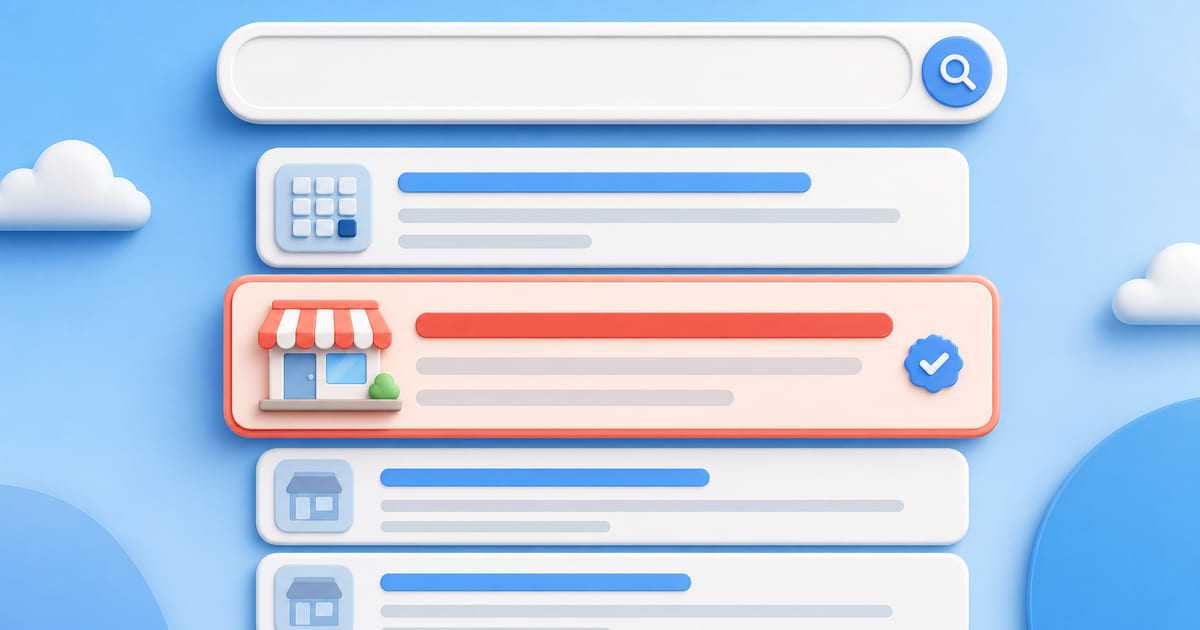
Get your profile complete and verified. A strong Business Profile usually takes the top of the page for a branded search, above the ordinary results.
Link to your site from everywhere you exist. Your social profiles, your listings, your suppliers' stockist pages. Each is a small signal that this domain is the official one.
Be patient. Branded searches generally resolve in your favour over months as the association strengthens. This is one of the cases where time genuinely does the work.
If your name is a common phrase
If you are called something like "The Corner Shop" or "Beirut Kitchen", you are competing against every use of those words.
Be consistent everywhere. Exactly the same name, spelled and punctuated identically, on every profile and listing. Half your listings saying "The Corner Shop" and half saying "Corner Shop" splits the signal.
Pair it with your location in your title and description — "Beirut Kitchen, Hamra" is a much more distinctive phrase than either half.
Accept that people will add context. Customers searching for you will type your name plus your town. Optimise for that phrase, because that is the real search.
If you are not indexed at all
Different problem entirely. Check with site:yourdomain.com — if nothing comes back, Google does not have your site, and no amount of branded-search work will help.
That is a separate fix: check for a blocking setting, submit a sitemap, make sure something links to you.
The one to do first
Claim and complete your Google Business Profile.
For a branded search by a local business, the profile panel usually appears above everything else — including the directory that is outranking your website. It is free, it works within days rather than months, and it resolves the practical version of this problem while the slower ranking work happens underneath.
The page that should be winning, and usually is not
If something else outranks you for your own name, the fix is almost always on one page rather than across the site.
Your homepage's title needs to contain your business name, plainly, at the front. Not "Home". Not a tagline with the name buried after a dash. The name, then what you do, then where — because that is the string somebody typed, and matching it exactly is most of the job.
That one field is the single highest-leverage thing on a small business site, and it is also the one most people cannot change themselves. It lives in the code on a hand-built site and behind a paid tier on several builders, so it gets set once by whoever launched the site and then never revisited even when the business renames itself.
On Helm the title and description of every page are fields in the dashboard, in both languages if you run in both, with the character counts shown so you can see where Google will cut it off. Which turns "our own name does not rank" from a project into an afternoon — and see how to write a good page title for what to put in it.