
Getting found · 5 min read
What does a retail shop need on its website?
The short answer
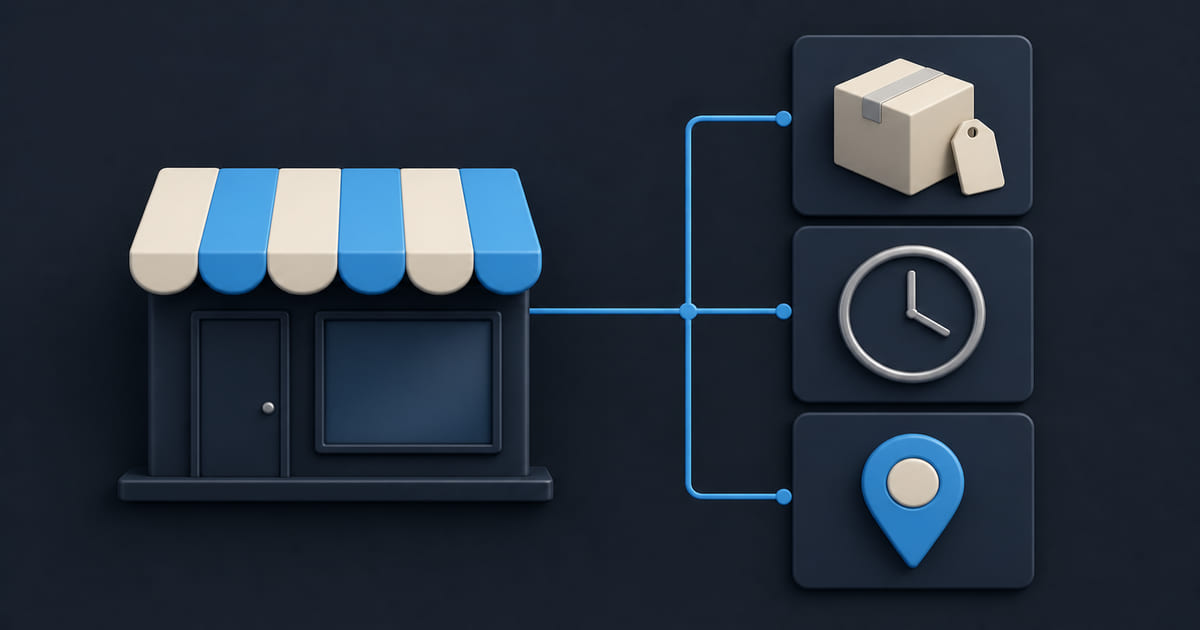
Not necessarily an online shop. Most people looking up a physical shop want to know whether you have the thing, whether you are open, and where you are — in that order. A page answering those three converts better than a half-maintained catalogue nobody buys from, and it takes a fraction of the effort to keep true.
On this page
What a local shopper is actually doing
Somebody has decided they want a thing. They are choosing where to get it, and they are on a phone.
They are checking three things, and almost nothing else:
- Do you have it, or something like it?
- Are you open, now or when I can come?
- Where exactly are you, and can I park?
Notice what is not on that list: your founding story, a rotating banner, a newsletter signup, and — for a large share of small shops — the ability to buy online. The visitor has already decided to come to a shop. They are deciding which one.
A site that answers those three quickly beats a beautiful site that buries them, every time.
Why the online shop usually should not come first
Building a store is the instinct, and for most small retailers it is the wrong first move. The reasons are in do I need an online shop, but the retail-specific version is worth stating.
A shop with a physical location already has a working sales channel. Adding an online one does not add customers — it adds operations: stock accuracy across two channels, packing, postage, returns. And the orders it produces at the start are few and low-value, which is the exact combination that loses money.
Meanwhile the thing that would genuinely bring people in — being findable, being visibly open, and showing what you stock — costs almost nothing and gets skipped because it is less exciting than a checkout button.
Build the second thing first. If it produces steady "do you have this" enquiries, you have proven demand and can add a shop knowing it will be used.
Show what you stock, without a catalogue
The compromise most small shops miss: you do not need every item priced and photographed to answer the question.
Show the ranges you carry. Brands, categories, price bands. "We stock X, Y and Z, roughly from A to B." That answers "do you have it" for most visitors without committing you to maintaining a catalogue.
Show what is new, and keep it recent. A short "just in" section, updated when things arrive, does more work than a full inventory. It also proves the shop is alive, which a static site does not.
Make it easy to ask. A WhatsApp link or a phone number for "do you have this in a medium" is a better answer than a stock system you cannot keep accurate, and it starts a conversation with somebody who is ready to buy.
The details that decide a visit
- Opening hours, correct today, including holidays and half-days. The single most common reason a shopper is annoyed with a small retailer is arriving at a closed door.
- Your exact location with a map link and, if it is relevant, one sentence about parking. "Free parking behind the shop" converts.
- Real photographs of the shop itself, inside and out. People want to recognise the door. Stock photography here is actively counterproductive — see should I use stock photos.
- Whether you can hold something. "Call and we'll put it aside" is a strong offer and almost nobody publishes it.
The one that is worth more than the website
Your Google Business Profile does more for a physical shop than your website does, and it is free. Photographs, hours, and the products or services fields. Somebody searching for what you sell nearby sees that before they see your site — see what is Google Business Profile.
The website's job is to be the thing they check second, after the profile has done its work.
What this looks like in Helm
Retail's specific problem is recency. A shop changes what it stocks constantly, and a website that describes last season is worse than a thin one, because it tells a shopper you have what you no longer have.
That makes the ability to edit the site yourself the whole game here rather than a convenience. On Helm the hours, the "just in" section, the ranges you carry, the photographs and the prices are fields — you change one and press Go Live, with a live preview and both languages in the same screen if you run in both. A shop that can update its own site on a Tuesday afternoon looks open in a way one that cannot never manages.
If you do sell online, the Shop module is shaped for a shop that also has a shop floor: a catalogue with variants, stock counted per variant so the site cannot sell what you no longer have, delivery regions with their own fees, and a restock worklist that puts the lowest stock first and shows how many people are waiting on each item. What it does not do is take card payments online — payment is cash on delivery, or Whish, OMT or bank transfer confirmed against your own statement — and it sends no order emails, so you find orders by opening the dashboard rather than your inbox. For three or four items rather than a catalogue, Offerings is the lighter option, on the same customer accounts as everything else. And Loyalty is a stamp or points card on your own site if you want a reason for locals to come back.
The short version
Answer the three questions a local shopper is actually asking, at the top, on a phone. Show your ranges rather than a catalogue. Get your Google profile right before you touch the website. And switch the shop on later, if the enquiries prove it is wanted — because a catalogue you cannot keep accurate costs you more than not having one.