
Bookings · 4 min read
How do I take restaurant reservations without a booking platform?
The short answer
Yes. Reservation platforms charge a monthly fee, a per-cover fee, or both, and they charge it on the regulars who would have called you anyway. Taking bookings on your own site costs a flat amount whatever your covers, and the diner never leaves your domain. Keep a platform listing only if it genuinely brings people who had never heard of you.
On this page
Do the annual arithmetic first
Reservation platforms price in one of three shapes, and the third is the one that quietly gets expensive.
A flat monthly fee is honest and easy to evaluate. A per-cover fee looks trivial per booking and is not: take a modest per-head charge, multiply by covers per week, multiply by fifty, and the number is usually a significant fraction of a staff wage. Both together is common on the tiers restaurants actually end up on.
Work out your own figure before reading anyone's feature list, because it changes the conversation. You are not deciding whether the software is worth having. You are deciding whether it is worth that much, every year, for ever, growing as you get busier.
The question that decides it
Same as it is for salons and gyms, and the answer matters more in hospitality because repeat custom is so much of the business: which diner is the fee being charged on?
Somebody browsing a reservation app for anywhere with a table at eight on Friday is a customer you did not have. Paying to reach them is buying marketing, and for a new restaurant it can be entirely worth it.
Somebody who already knows your name, typed it into their phone, tapped the first result and landed on your platform listing is a customer you already had. That fee bought nothing. And for an established restaurant, that second group is most of your bookings — which is precisely when the per-cover model becomes most expensive.
Three things your own booking page must get right
If you are going to take bookings yourself, the page has to be good, because a page people abandon sends them back to the app and you pay the fee anyway.
Real availability. Not a contact form that says "we'll confirm". Diners deciding at 6pm for 8pm will not wait for an email. If you genuinely cannot offer live tables, be explicit that it is a request and confirm within minutes — the failure is the ambiguity, not the model.
It has to work on a phone, one-handed, in about twenty seconds. Date, time, covers, name, number. Every extra field costs you bookings.
The policy visible before booking, not after. Deposit, cancellation window, large-group rules. Discovering a deposit at the last step is the single most common reason a booking is abandoned, and it also produces the angry review later.
The part restaurants forget
Whichever route you choose, the reservation is not the whole job.
Your opening hours must be right everywhere — the site, the Google profile, and the platform if you use one. Holiday hours especially, which is where most restaurants get caught. A diner who books, travels and arrives at a closed door writes a review that costs more than a season of fees. See holiday opening hours on your website.
Your menu must be real text. A diner deciding between three restaurants at 6pm is reading menus. If yours is a photograph or a PDF, you lose that comparison and you are also invisible to the search and AI queries covered in will AI assistants recommend my restaurant.
What this looks like in Helm
Bookings is a module on the same dashboard as your website, so the menu, the hours and the reservation system are one thing rather than three subscriptions that disagree with each other.
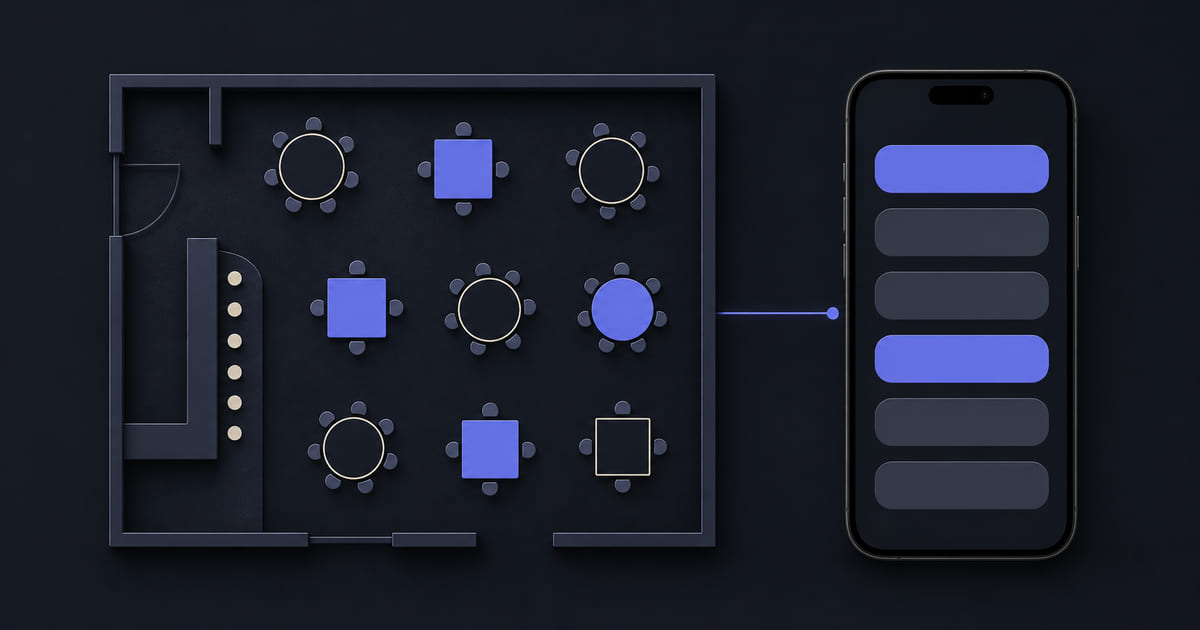
You get a booking requests inbox and the bookable tables or spaces behind it. The form sits on the site you already have, on your own domain, so a diner who searched your restaurant by name never leaves it. The cost is flat — a full Saturday costs the same as an empty Tuesday, which is the whole point next to per-cover pricing.
The menu and the opening hours are fields you edit in a minute, in Arabic and English if you run in both. That matters more than it sounds for this specific problem: the reason hours are wrong on the site is almost never that nobody knew, it is that changing them meant asking somebody.
And if you want a reason for people to come back, Loyalty runs on the same customer accounts — a stamp or points card with a reward you choose, redeemed at the counter, living on your own site with nothing for the diner to install.
The arrangement most restaurants should land on
Keep a platform listing if, and only if, you can point to genuinely new diners it brings. Take your own bookings on your own site for everyone else. Make sure that when someone searches your restaurant by name, your site is the first result rather than the listing.
Then you are paying to acquire new customers and nothing at all on the regulars — which is roughly the deal you thought you were signing in the first place.