
The basics · 3 min read
How many photos should my website have?
The short answer
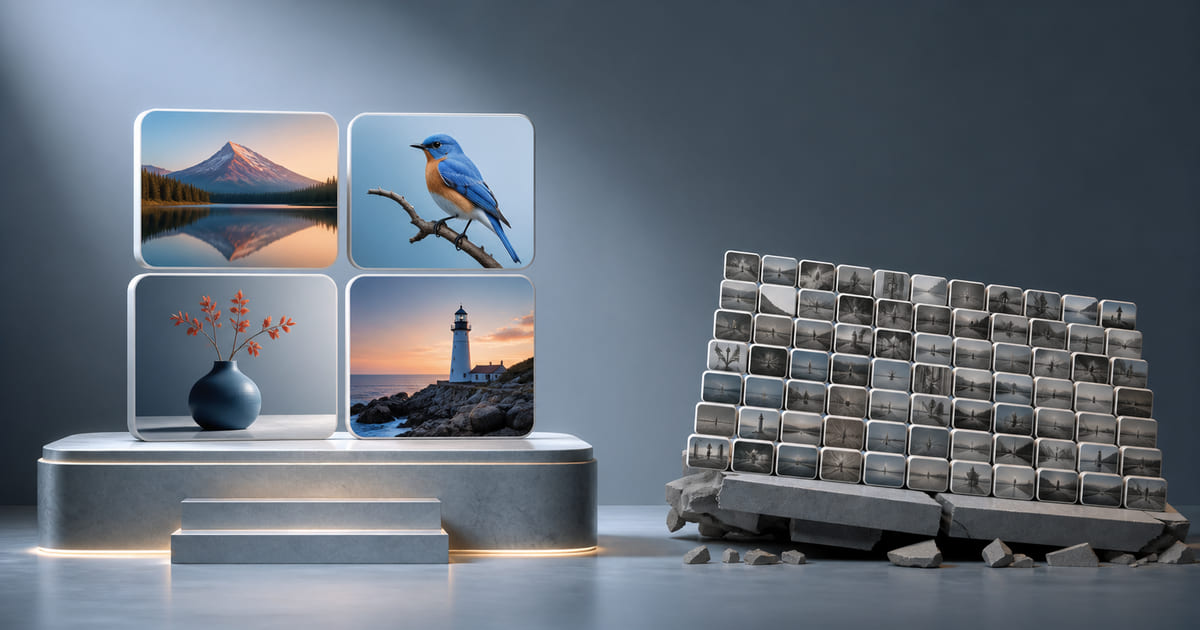
Far fewer than most sites carry. Six to twelve genuinely good ones covering the things people want to see, rather than forty variations nobody looks at. Every extra image costs load time, and a slow page loses more visitors than an extra photograph gains. Choose ruthlessly and size them properly.
On this page
The number
For a small business site: six to twelve good photographs, total.
Not per page — total. A café needs the exterior, the room, a few dishes, and the team. A tradesperson needs the van, a few finished jobs, and themselves. That is the whole requirement.
Sites carrying forty images are almost always carrying thirty they do not need.
Why more actively costs you
Load time. Every image is a request and a download. This is not a marginal effect — oversized images are the single most common cause of a slow small business website, and slowness loses visitors before they see any of the photographs. How fast is fast enough is a number worth knowing before you start cutting.
Attention dilutes. Twelve views of the same room means each one is worth less. One excellent photograph of your best table does more than six adequate ones.
Maintenance. Every image is something that can become out of date. Forty photographs from before a refurbishment is forty things misleading people.
Nobody scrolls a gallery. The evidence on this is consistent: visitors look at the first two or three and leave. The rest is weight with no readership.
What each one should earn its place for
Rather than counting, ask what job each does:
- The exterior — so people recognise your door
- The main room or workspace — so they know what it is like
- What you actually sell, two or three of the best
- The people — one shot of the team or of you working
- Anything people always ask about — the parking, the accessible entrance, the private room
That is six to ten photographs for most businesses, and each one answers a real question. If a photograph does not answer one, it is decoration.
The exception
Portfolio businesses genuinely need more. A photographer, a builder showing finished work, a salon showing colour work. Here the images are the product.
Even then: put the best ten on the main page and the rest behind a link, load them lazily so they only download when someone scrolls, and keep them properly sized. A portfolio can be extensive without being heavy.
The technical part that matters most
Resize before uploading. A photograph from a phone is often several megabytes; the version needed for a web page is a small fraction of that. Uploading originals is the mistake that makes sites slow, and it is invisible to whoever uploaded them because their browser has cached everything.
Use a modern format if your platform supports it — substantially smaller at the same quality.
Lazy-load anything below the fold, so images further down do not delay what someone is looking at now.
Write alt text for each one — what it is and why it matters.
The test
Load your site on your phone, on mobile data, with wifi off.
If the images take noticeably long to appear, you have either too many or ones that are too large — and it is almost always the second. Fixing that is an afternoon and it changes the experience more than any photograph you could add.
The number matters less than the routine
Whatever number you settle on, it decays the way everything else on a website does — and the failure mode here is specific: sites gain photographs and never lose them.
The gallery grows because adding is easy and pruning requires a decision. Three years in there are forty images, half from the old fit-out, and the page takes six seconds on mobile data. Nobody chose that. It accumulated.
So the useful practice is not a target count but an occasional cull. Twice a year, open the page on a phone using mobile data rather than the office wifi, and remove anything not earning its place.
That takes ten minutes when photographs are fields you control, and never happens at all when removing one means emailing somebody — which is exactly why most sites only ever gain weight. Helm's contribution here is unglamorous and real: it makes removing an image as cheap as adding one.