
The basics · 5 min read
How do I create a website for my business?
The short answer
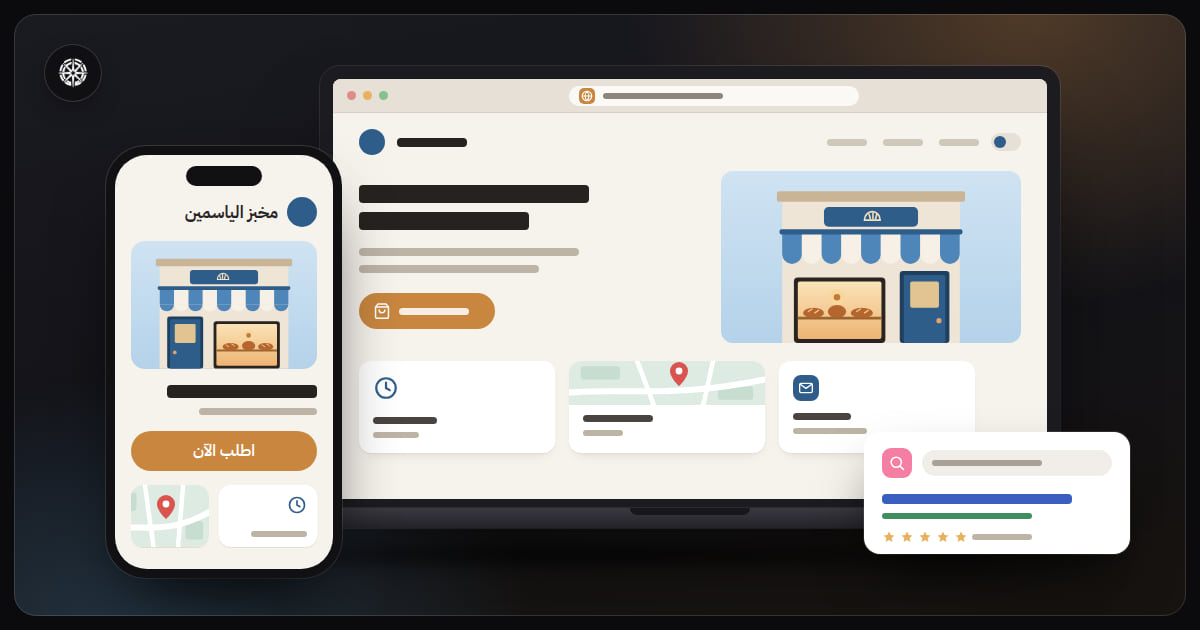
Decide what customers must be able to do on the site, register a domain in your own name (.com, plus .sa or .com.sa in Saudi Arabia, or .com.lb in Lebanon), choose who builds it, and write it in Arabic and English from the start. Show your hours, location and contact details on every page, and link it to Google.
On this page
Most people start building a website by choosing colours. Start instead with one question: what should a customer be able to do on it without calling you?
For a café, that is reading the menu and the hours. For a salon or a clinic, it is asking for an appointment. For a shop, it is ordering. For a studio or a consultant, it is sending an enquiry with enough detail to quote. The answer decides almost everything that follows.
1. Write down what the site has to do
Make a short list, in this order:
- What do people ask you most? Hours, prices, where you are, whether you deliver. Each of those belongs on the site, so the question stops arriving by message.
- What do you want them to do? Book, order, enquire, or visit. Pick the one that earns you money and make it the main button on every page.
- Who keeps it up to date? If the answer is "whoever built it", every price change becomes a request. Choose a setup where you can edit your own hours, menu and photos.
2. Register your address
Your domain is your business's address online, and it is worth getting right once. The short, sayable name matters more than the ending; how to choose a domain name covers that part.
- Saudi Arabia. SaudiNIC registers Saudi names for applicants with a Saudi link: an entity located in Saudi Arabia, a Saudi national or Premium Residency holder, an entity licensed there, or the owner of a trademark registered there. Within that,
.sais "dedicated to any natural person or legal entity", while.com.sais "dedicated only for entities that provide commercial services with a valid Commercial Registration (or equivalent)", or for a locally registered trade name or trademark (SaudiNIC regulations). SaudiNIC licenses registrars to handle registration. - Lebanon. The registry, LBDR, says registrants under
com.lb,net.lbandorg.lb"must have a Lebanese postal address". It "does not register domain names directly": you apply through one of its accredited registrars (LBDR policy). - Anywhere. A
.comworks in every market. Many businesses register both, the local name and the.com, and point one at the other.
Keep the domain in your own name or your company's, not your developer's. See who owns my website for why that matters later.
3. Choose who builds it
There are three usual routes:
- A website builder. You assemble it yourself from a template. Quick to start, and you do all of the work.
- A developer or agency. They design and build it for you. See choosing a web development company in Lebanon for what to ask before you sign.
- A business platform. The site is built for you and comes with a dashboard where you run the business behind it. Helm works this way: Helm builds your site, or connects the one you already have, and you get a dashboard in Arabic or English where you edit your pages and read your enquiries yourself and, depending on what your site needs, handle bookings, orders and customer accounts.
Whichever route you choose, ask to see the dashboard you will use every week, not only the finished homepage.
4. Do Arabic properly, from the start
Arabic is not a translation you add at the end. It reads right to left, so the whole page turns: menus, buttons, arrows and forms. A site that only flips its text looks broken to an Arabic reader.
It is also an opportunity. In October 2026, W3Techs counted Arabic as the content language of 0.6% of the websites whose language it knows, against 49.5% for English (W3Techs, content languages). Fewer sites are written in Arabic, so a well-made Arabic site has fewer pages competing with it when someone searches in Arabic.
Practical rules:
- Write both versions properly, rather than running one through a translator.
- Give each language its own address (for example
/ar/), so Google can show the right one. - Check every page on a phone in both languages before it goes live.
The details are in how to add Arabic to my website and Arabic website design mistakes.
5. What every page needs
- Your opening hours, kept true, including Ramadan and holiday hours.
- Where you are, with a map link.
- A way to reach you: a phone number, a WhatsApp link, and a form for anything longer.
- Your main button: book, order or enquire.
- Real photos of your place, your products and your team.
The homepage carries more than that, in a deliberate order: see what should be on my homepage.
6. Get found
A new site is invisible until Google knows about it. Set up your Google Business Profile with the same name, address and hours as the site, and link the two. Then follow how to get my website on Google.
Put the site's address everywhere else people already find you: your WhatsApp Business profile, your Instagram bio, your receipts and your shopfront. Every one of them should send people to the same site.
The short version
Decide what customers must be able to do, register your domain in your own name, pick who builds it, write it in Arabic and English from day one, and link it to Google. If you would rather have the site built for you and run the business from one dashboard in Arabic, start a project with Helm.