
Choosing a platform · 4 min read
Do I need an app for my small business?
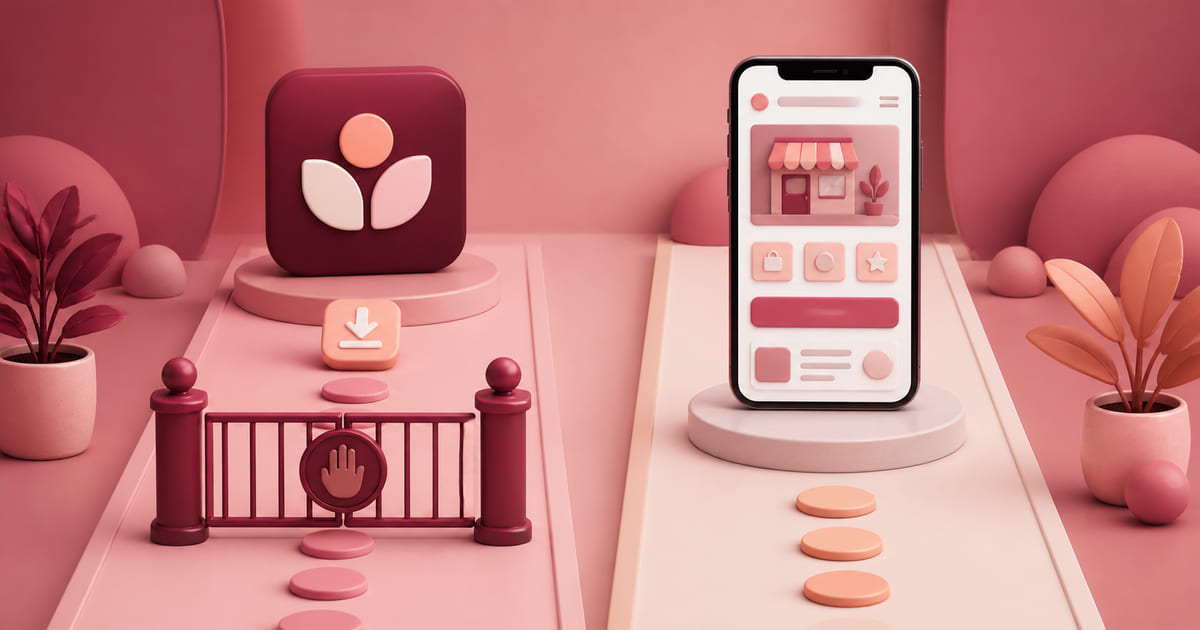
The short answer
Almost certainly not. An app requires someone to find it, download it, and keep it installed — three barriers a website does not have — and it needs continuous maintenance to keep working as phones update. Apps make sense when customers interact many times a month and the app does something a website genuinely cannot. For most small businesses, neither is true.
On this page
The three barriers
A website is one tap from a search result. An app has to clear three separate hurdles before it does anything for you:
Discovery. Nobody browses an app store for a local café. They have to already know you exist and be motivated enough to go looking.
Installation. A download, storage space, a decision. Every step loses people, and this one loses most of them.
Retention. Phones get replaced, storage gets cleared, apps that go unused get deleted. An install is not permanent.
A website skips all three. Somebody searches, taps, and is using it. That difference is why the comparison is rarely close for a small business.
When an app is genuinely right
Three conditions, and you need all of them:
High frequency. Customers interacting several times a month, not several times a year. A daily coffee, a gym, a regular delivery. If someone uses you twice a year, they will not keep an app installed for it.
Something a website cannot do. Push notifications that people actually welcome, offline use, deep device features. Note that most of what people want apps for — bookings, ordering, loyalty cards — works perfectly well on a website now.
Enough customers that the maintenance divides sensibly. An app is not built once. Operating systems update, requirements change, store policies shift. That is an ongoing cost against a fixed customer base.
Chains and delivery platforms meet all three. Individual cafés, salons and trades almost never do.
What people actually want when they ask for an app
Usually one of these, and each has a cheaper answer:
| What they want | What actually delivers it |
|---|---|
| Loyalty scheme | A digital card, no install needed |
| Easy repeat ordering | A website that remembers them |
| Push notifications | Email or messaging, which they already read |
| To feel modern | A fast, well-built website |
| To be on their home screen | A website can be added to it |
That last row surprises people. A modern website can be saved to a home screen with an icon, opening full-screen like an app — without a store listing, a download, or an approval process.
What it costs to keep one alive
The build is the smallest number. Afterwards:
- Two platforms to maintain, or one and an unhappy half of your customers
- Updates when operating systems change, which is annual and non-optional
- Store policy compliance, which changes without asking you
- A new release for every content change, unless it was built to avoid that
- Someone to handle it, indefinitely
An app that stops being updated stops working within a couple of years. A neglected website merely goes stale; a neglected app breaks.
The honest recommendation
Build the website properly first: fast, works one-handed on a phone, prices and hours easy to find, bookings or ordering that take three taps and no account.
Do that, and the reasons to want an app mostly evaporate — because the things you wanted it for are working, without asking anyone to install anything.
If after a year you have thousands of genuinely regular customers asking for an app by name, revisit it. That is a good problem, and by then you will have the evidence to justify the cost rather than the hope.
The things people wanted the app for, without the app
Look back at that list and the pattern is that almost none of it needs an app. It needs a logged-in customer — which a website can have.
Loyalty is stamps, points and a code to redeem them. Bookings is a form and an inbox. "Somewhere my regulars can see their history" is a customer account. A members' community is a feed with posts and comments. Session credits are a number attached to a person. Every one of those works in a browser, on a phone, with nothing to install and nothing waiting on an app store's approval. A daily coffee is the clearest case, and a coffee shop loyalty card is the worked example.
On Helm they are modules in the same dashboard as your site: Loyalty, Bookings, Customers, Community, Offerings, Coaching, PT sessions. You switch on the ones your business uses and the rest are not there cluttering the sidebar. That is not an argument that apps are never right — the section above sets out when they are. It is an argument that most of what makes an app appealing is available a year earlier, and for a fraction of the cost.