
AI and websites · 4 min read
Can AI actually build a website for my restaurant?
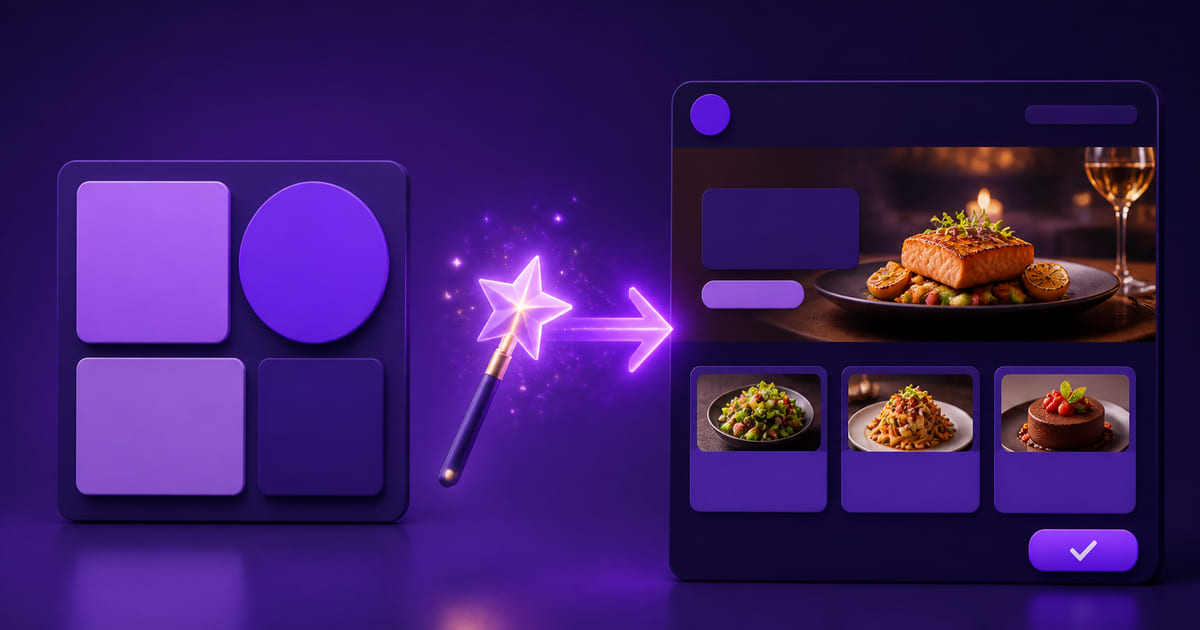
The short answer
Yes, and much faster than a traditional build — a described brief can become a working site the same day. What AI does well is structure, layout and first-draft copy. What it cannot do is know your business: your actual prices, your real photographs, what makes your room worth crossing town for. Treat the output as a strong first draft you correct, not a finished site.
On this page
What has actually changed
A few years ago "AI website builder" meant a template picker with a chatbot bolted on. That is no longer what this is. You describe your business in a few sentences and get back a real site — structure, layout, styling and written copy — in minutes rather than weeks.
The output is genuinely usable. It is also, and this is the part worth being precise about, a draft.
What AI does well
Structure. It knows a restaurant site needs a menu, hours, location, a way to book and a reason to care, and it will not forget one. Left to themselves, most people forget the hours.
Layout and styling. Spacing, hierarchy, type pairing, mobile behaviour. This is craft that used to be the expensive part, and it is now close to free.
First-draft copy. Serviceable words in every slot, immediately. Much easier to correct a paragraph than to write one facing an empty box.
Speed. The honest headline. Same-day instead of six weeks changes what is worth doing at all.
What it cannot do
Know your prices. It will invent plausible ones. Plausible is worse than blank, because plausible does not look wrong until a customer arrives expecting it.
Know your photographs. Generated or stock imagery of food is the single fastest way to look like every other site. Your actual room and your actual plates are the most valuable thing you own here, and no model has them.
Know what makes you worth choosing. It can write that you use fresh ingredients. It cannot write that your grandmother's recipe is the reason people drive forty minutes, because nobody told it.
Be accountable. If a claim on the page is wrong, it is your business that made it.
The pattern that works
Treat the generated site as scaffolding you correct, in this order:
- Facts first. Prices, hours, address, phone, anything that can be wrong. This is not a design task and it is the only genuinely urgent one.
- Photographs next. Swap generated or stock images for real ones. This is the highest-value hour you will spend on the whole site.
- Then the specific sentences. Find every line that could sit on a competitor's site unchanged and replace it with something only you could say.
- Design last, if at all. It is usually already fine, and it is where people burn time avoiding the harder steps above.
The question worth asking before you start
Not "can AI build my site" — it can. Ask what happens the day after it is built.
A generated site you cannot edit has the same problem as a custom site you cannot edit: the first price change puts you back in a queue. The useful version continues into a dashboard, so the site you generated on Tuesday is one you can still change yourself in March.
That continuity, not the generation, is what decides whether this saved you time or just moved the cost.
What that continuity looks like in practice
The continuity described above is the entire design of Helm AI, so it is worth showing its shape rather than asserting it.
You describe the restaurant — what it is, who eats there, what the room feels like — and you upload what you already have: your logo, your photographs, and a picture or PDF of your actual menu. It reads the menu, pulls out the real dishes and the real prices, and shows them to you to correct before anything is built. Then it designs the site from a blank page rather than filling in a template, and writes the actual code. The build takes minutes, not weeks, and you see the live site in front of you before you commit to it.
Two details worth knowing, because they are where generated sites usually disappoint. The photographs are yours or licensed stock, never invented — an AI-generated picture of food you do not serve is worse than no picture. And the design tweaks happen in the builder while the content changes happen afterwards in the dashboard, which is deliberate: the menu, the prices, the hours and the SEO title on each page are yours to change from that point on, in a minute, without joining a queue.
If you already have a site you like, that route exists too — attach it and get the same dashboard without regenerating anything. And if you would rather a person did the design, the team builds a custom one in days. Three routes in, one dashboard afterwards, which is the part this article says actually decides the outcome.