
Lebanon · 5 min read
Which delivery companies work with online shops in Lebanon?
The short answer
Wakilni, Aramex, LibanPost, Pick App and ToDoor all deliver for shops in Lebanon, and Wakilni and ToDoor collect cash on delivery for you. Many shops also use their own driver. Whichever you pick, charge delivery by area: a fee and a time for each area, and free delivery above an amount.
On this page
Selling online in Lebanon means two decisions about delivery: who carries the parcel, and what the buyer pays for it. This guide covers the delivery companies Lebanese shops use, what to ask before you sign with one, and how to set your delivery prices. If you are still setting up the shop itself, start with how to open an online shop in Lebanon.
Delivery companies that work with online shops
Each line below is what the company's own website says, read on 16 October 2026. Prices and areas change, so ask each one for a current quote.
- Wakilni. It calls itself "an e-commerce fulfilment partner for small to medium e-commerce businesses", and it can store your stock, pack orders and deliver them. It covers two zones: Zone A is "Beirut from Jnah to Dbayeh and all the way up to Baabda", delivered in 1 to 2 working days, and Zone B is "the other areas in Lebanon", in 2 to 3 working days. Payment can be "cash or credit card on delivery", and it pays you back "once a week or twice a month". For its courier service, its delivery page gives a range of "$6 - $15+" (Wakilni, Wakilni for e-commerce, Wakilni delivery).
- Pick App. It delivers nationwide from its headquarters in Baabda, with relay centres in Zgharta, Saida and Chtaura, and "an average of 3000 orders/day". You can choose "next-day delivery, express delivery or customized delivery timings", and it offers "cash on delivery, credit card and on-account payment options" (Pick App).
- ToDoor. It offers "same-day delivery across Lebanon" for shops, pharmacies, restaurants and online stores, with daily pickups from your shop. It collects "payments on your behalf upon delivery" and transfers them back to you (ToDoor).
- Aramex. Its Lebanon site offers a business account for online shops and small businesses, with "same-day domestic deliveries" and pickup points, so a parcel can wait at "an Aramex outlet, locker or any of our retail partners closest to your customer" (Aramex for e-commerce and SMEs).
- LibanPost. The postal service says it "will collect on your behalf any product, document, or payment from your customers", and its home collection service collects "your money directly from your customer’s home or work address". Its parcel service takes packages under 30 kg (LibanPost collection, home collection, LibanPost parcels).
A delivery app, or your own driver
Toters works differently. It is a delivery app: buyers discover stores and restaurants in it and order there, paying "by card or cash", and stores join it as partners to "reach new customers" (Toters).
Your own driver. Many shops deliver with their own driver, or use one for nearby areas and a courier for the rest. The rest of this guide applies just the same: a price and a time for each area your driver covers, and cash taken at the door counted when it reaches you.
What to ask before you sign
Ask each company the same five questions, and get the answers in writing:
- The price for each area you deliver to, and whether a heavy or bulky parcel costs more.
- How the cash comes back. When a buyer pays the courier, how often is it paid to you, and how? Wakilni's answer, for example, is once a week or twice a month.
- What happens when nobody is home, and what a return costs you.
- Which currency the courier collects in, so the amount on your order matches what the buyer is asked for at the door.
- How you and the buyer track the parcel.
How to charge for delivery
A small shop has three ways to charge for delivery: one flat fee, free above an amount, or a price for each area. Shipping for a small online store weighs them up. Wakilni, for one, splits Lebanon into Zone A and Zone B, and the simplest delivery prices follow a map like that.
- Name a few areas, each with a price and a time. Two can be enough. If your courier charges you different prices for different places, add an area for each price.
- Give a time with each price. "Beirut, 1 to 2 days" answers the buyer's next question before they ask it.
- Offer free delivery above an amount, set high enough that the order still pays for the courier.
- Show the delivery price before the checkout. A fee that first appears at the last step gives the buyer an easy reason to leave.
If a courier collects cash for you, its fee for that belongs with the payment method, not with delivery. That keeps your delivery prices the same for every buyer. The Whish, OMT and cash on delivery guide shows how.
How a Helm shop prices delivery
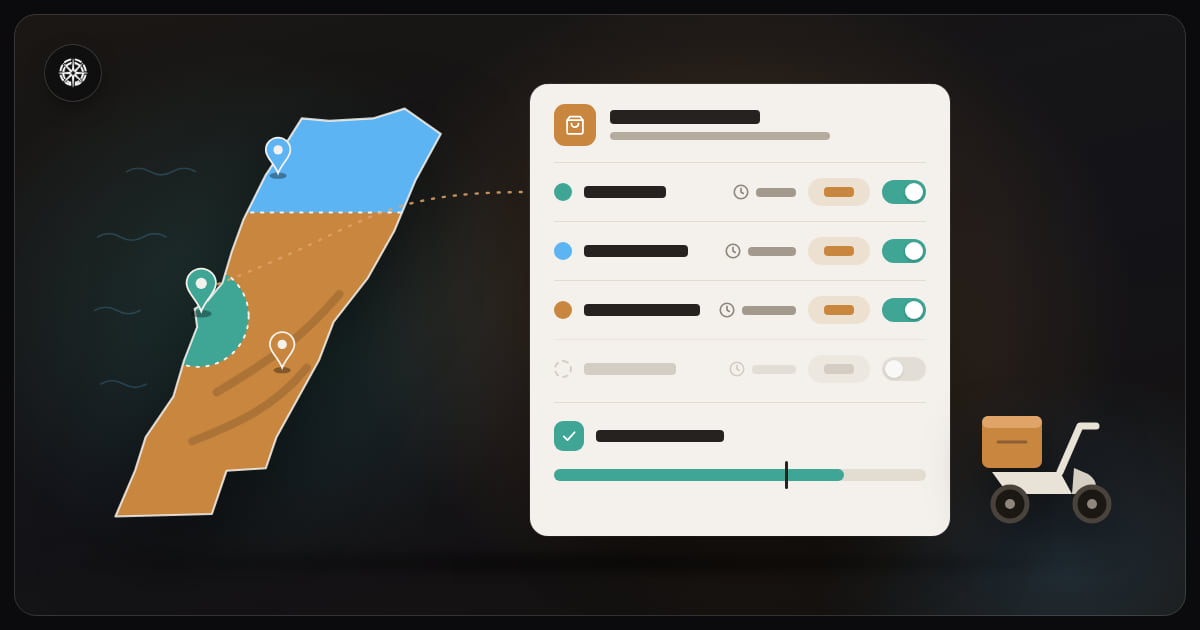
In a Helm shop, delivery is set up in one place, Where you deliver. You add each area with its cost and how long it takes, and switch an area off when you stop delivering there.
- The buyer picks their area at checkout, and its fee goes on the order.
- Before they pick, the cart shows your cheapest area's fee as the estimate.
- Under Free delivery, you can set an amount above which delivery costs nothing.
- Every order shows the area it is going to, so you know which courier zone to book.
The shop is available on the Standard and Business plans. To see how payment works alongside it, read taking online payments in Lebanon. Whichever courier you choose, put your areas and prices on your site before the checkout. That way the buyer knows the full price before they decide.